History
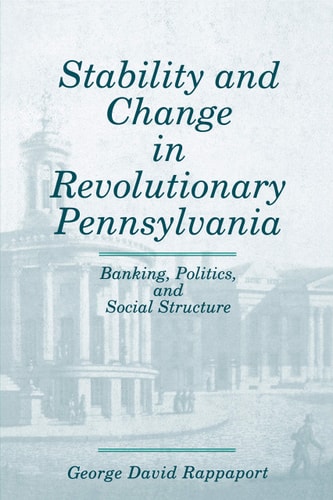
Stability and Change in Revolutionary Pennsylvania
- Dispatched from London tomorrow
- Tracked UPS delivery worldwideUsually arrives 12–18 Nov
- 30-day returnsHow returns work
- Format
- Paperback
- Pages
- 300
- Published
- 1996
- Publisher
- Pennsylvania State University Press
About this book
The story
Did the Quaker province become truly modern between 1740 and 1790? George Rappaport's answer is no, though by 1790 the process had begun. Using explicit social-scientific models, he maps Pennsylvania's social order: families, communities, parties, classes and voluntary associations from firefighting companies and immigrant aid societies to Benjamin Franklin's Junto. He finds an economy not yet capitalist, a politics strikingly modern, and a traditional society maturing just as a new one stirred.
The second half turns to Philadelphia in 1781 and the founding of the Bank of North America, the country's first commercial bank. Rappaport follows the Constitutionalist Party's repeal of its charter and the campaign by Robert Morris and the directors to survive and restore it, reading early banking and antibanking as a preview of America's modernisation. A rigorous study for readers of early American economic and social history.
If you like this
You might also like
From the same author, publisher and shelves.